How to reach government decision makers
Map the people who fund, evaluate, and approve a government purchase, then reach them with verified contacts, better timing, and the right channel.

A government purchase is rarely decided by a single person whose title matches your buyer persona. The department that wants your product, the office that controls the money, and the staff who score your proposal are usually different people, but all involved in the purchase decision.
This guide explains how to identify government decision makers within a state agency, city, county, school district, or university, verify their contact details, and time your message so it arrives in the right budget cycle.
How do you reach government decision makers?
Reaching government decision makers means identifying the few people who fund a purchase, evaluate it, and run the procurement within one agency, district, or campus. Confirm that each person’s role and contact details are still current, then reach out while that organization is still deciding what to fund rather than after an RFP is posted.
The government and education decision makers who control budget, evaluation, and approval
While the principles here apply to public sector sales broadly, this guide is primarily focused on the SLED (State, Local, and Education) market.
Government and education purchases split authority across funding, evaluation, and procurement.
Budget approval sits on the funding side, while the procurement office runs the competitive process and in some organizations selects the vendor.
Each account therefore needs a name attached to all three functions.
The budget owner controls whether money exists for the purchase at all, and that person is usually not the staff member who wants your product.
Towson University illustrates the split: the university’s procurement page states that non-grant-funded requisitions from $50,000 to $149,999 must be approved by the divisional vice president. Requisitions of $150,000 and above need both the divisional vice president and the chief financial officer.
Technical evaluators score what you submit.
Oregon’s state procurement manual, for example, separates scoring from procurement facilitation and recommends including at least three agency staff who know the product or service being purchased. The manual puts the procurement professional in the room as a facilitator and advisor rather than a voting member.
The procurement office decides how the purchase is run, and in some organizations it also picks the final vendor.
Those functions go by different titles in each segment.
- In a city or county, a department director evaluates the product, a city or county manager or administrator typically decides whether the funding request reaches the governing body, and a procurement director processes the competitive bid.
- In a school district, the superintendent sits on the funding side, the chief technology officer evaluates what you are selling, and a purchasing director processes the purchase and, in districts like Tacoma, selects the vendor.
- On a campus, a department chair or dean evaluates the product and a central procurement office processes the purchase, which is one reason higher education procurement often does not follow the org chart.
Thresholds and committee rules vary by organization, so treat the split between funding, evaluation, and procurement as variable. Sales reps should check the specifics for each account.
Why generic B2B contact databases don’t work in government and education
Government and education contact records fail in two main ways:
- They source heavily from LinkedIn and other commercial databases. Many government and education officials have little or no LinkedIn presence, so the relevant buyer may never enter the database in the first place.
- The records they do capture go stale. Public sector employees change roles, departments, and responsibilities, but those changes may not appear quickly in the commercial sources B2B databases rely on.
The result is a contact database that can miss the right public sector buyer entirely or point a rep toward someone who no longer owns the problem.
For example, ILO Group’s Superintendent Research Project reported in September 2025 that 114 of the top 500 districts, or 23%, had at least one leadership change during the year it measured, up from 20% the year before and above pre-pandemic averages of 14 to 16%.
At that rate, a year-old list of those districts names a former superintendent in roughly one in four of them.
That count covers only those 500 districts and the superintendent role. It does not describe technology directors, business officials, or city managers. Interim appointments and reorganizations can make a contact record outdated even when the person remains at the organization, which a bounce report will not flag.
Generic B2B contact databases can underrepresent the staff who evaluate a district or city purchase and the office that runs the procurement. Check any list you buy for both functions before your team uses it.
Treat a purchased record as a lead on a person rather than a verified way to reach them, and add a verification step before every campaign to a government or education account.
Where to source and verify current government and education contacts
A state agency, city, county, district, or campus often publishes staff contact details you can verify yourself.
For instance, Washington State publishes an employee directory searchable by agency or by an employee’s first or last name. Other states, districts, and campuses publish similar directories, though the fields vary, so check what a given directory lists before you rely on it.
Remember that a directory shows who occupies a role, not who owns a purchase. Board agendas and minutes help add decision context that staff directories do not show.
Verifying a contact before the send
Verify each contact against the organization’s own directory or a recent public document, not against the vendor record you started from.
Record the date you last verified each contact at your top accounts, so a rep can tell a checked record from an assumed one.
The work of checking every record by hand grows with the size of the territory. Reps end up manually searching and building lists in spreadsheets, which takes hours and still leaves some addresses that bounce.
If you want to automate the manual lead research process, consider Starbridge.
Starbridge is the AI GTM platform for companies selling to the government, K-12, and higher education, helping teams prioritize the right accounts, engage the right people earlier, and identify high-intent opportunities before the competition.
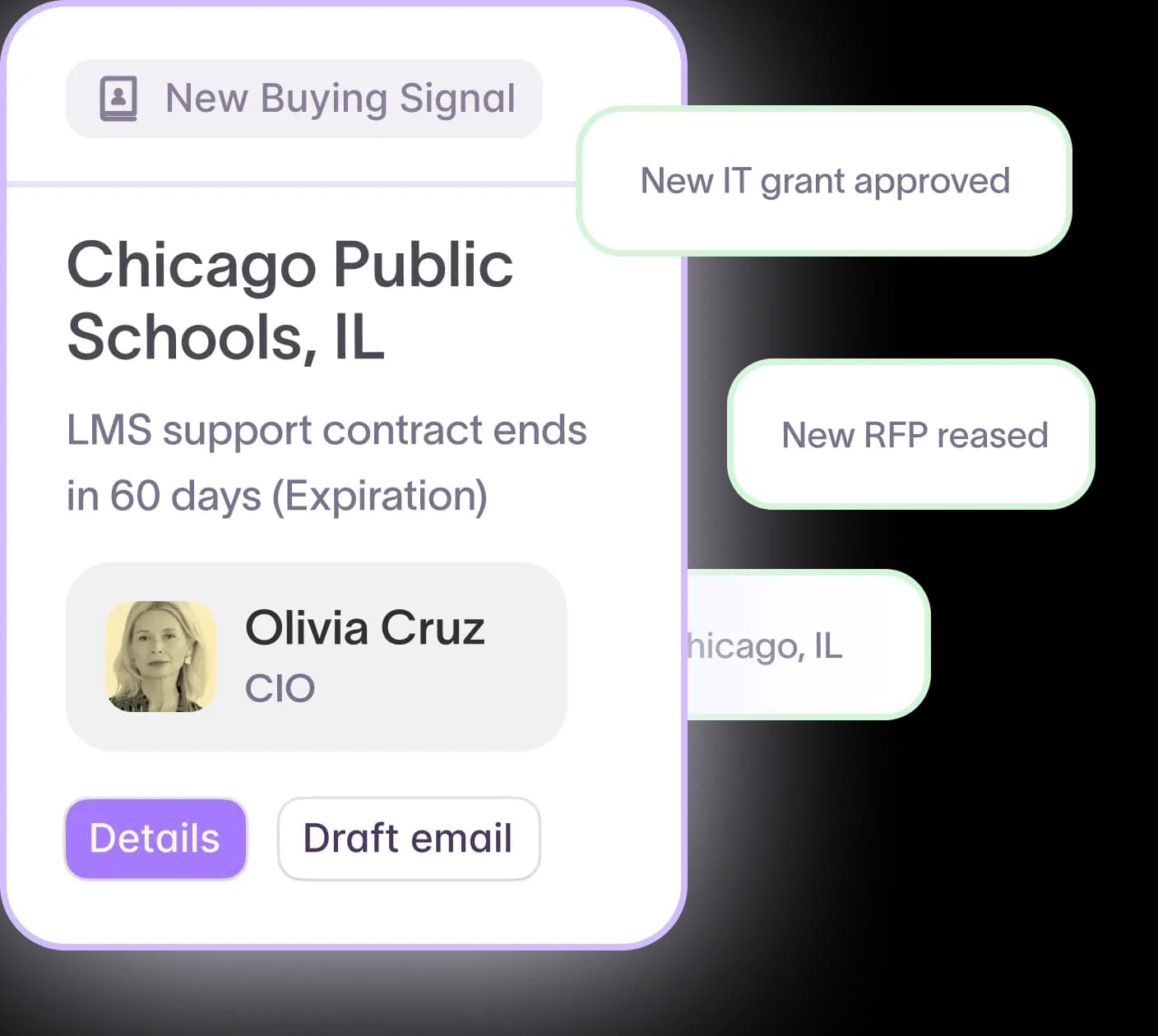
Reps open a daily feed of verified decision makers that gives each contact’s name, role, and email address at a named account. Starbridge reports a 2% bounce rate on its contact data and 98% contact accuracy, achieved by continuously crawling official .gov and .edu sites.
TAM to Target reports Starbridge contact data was 3 to 4 times more valid than the data from the other contact vendors its team had worked with, which removed the manual data verification the team used to run.
Timing outreach to a government or education buyer around board and budget activity
Board and budget activity help you reach the department while it is still deciding what to request.
In a two-year state budget cycle, that request can appear in public records months before an RFP reaches a bid portal.
Oregon’s state budget process illustrates that lead time: agencies start the budget early in even-numbered years to develop their Agency Request Budget and send that request to the state’s Chief Financial Office by September 1. The Governor presents the recommended budget to the Legislature when it meets at the start of the next calendar year.
On a calendar like Oregon’s, a vendor who first hears about the need when an RFP is posted has missed the cycle in which the agency requested that funding.
Budget calendars differ by state, city, district, and campus, so find the request and adoption dates at your top accounts. Agenda posting windows then show how close an item is to a public meeting.
For example, San Francisco Unified posts a regular board meeting agenda twice: a draft agenda 12 days before the meeting, then the final agenda 72 hours before the meeting starts. Both appear on the same board meeting calendar and agendas page.
At San Francisco Unified, a purchase that has reached the draft agenda is under two weeks from a scheduled vote, which is too late for a vendor to help shape the requirement.
Read the item to learn what the district buys and who brings it forward, then time your outreach to that account for the next budget cycle.
What to watch at a named account
At each named account, watch the public records that show a date you can work back from:
- Strategic and capital plans, which show the priority behind both
- Leadership changes, which show who now owns the priorities and vendor relationships
- Board and council agendas, which discuss problems the buyer is facing, what use cases you can solve, and what will likely be approved into budget next cycle
- Proposed and adopted budget documents, which show what a department asked to fund
Score and rank these budget, agenda, plan, and leadership records so reps work the strongest ones first.
Starbridge’s Buying Signals Monitor reads budget, agenda, plan, and leadership records across more than 320,000 government and education entities around the clock, then delivers each piece of pre-RFP buying activity with the account, the reason the timing is right, and the person to contact.

Choosing between email, phone calls, referrals, and conferences
Choose the outreach channel based on the person’s function, seniority, and what is currently happening at the account.
Use email as the default for most contacts. Use phone calls when the role is accustomed to vendor inquiries or there is a specific reason to speak now. Use referrals and conferences to create warmer paths into senior officials who receive heavy vendor outreach.
The same approach should not apply to every person on the buying committee. A procurement officer, department evaluator, CIO, and superintendent each have different reasons to engage with a vendor.
Email reaches staff-level contacts and scales across a whole territory.
Write to a work address the organization publishes, and assume the message can become part of the public record, so keep it short and factual.
The public sector email marketing guide covers cold-email legality and how to build each message from a document the agency already published. The higher education email marketing guide covers who to write to on a campus and how to time the send to the university budget year.
Phone calls
Use phone calls selectively rather than treating it as the fallback when email does not work.
Procurement staff and other operational contacts are reasonable people to call when you have a concrete question about a purchasing route, requirement, or active initiative.
Raise the threshold for senior executives such as CIOs, superintendents, presidents, and city managers. They receive more unsolicited vendor outreach, so a cold call without a specific reason can hurt rather than help. Start with a relevant email, referral, or in-person introduction unless research gives you a reason to call directly.
When a solicitation is already active, check its communication rules before calling anyone. Some procurements restrict vendor communication to a designated contact.
Keep both the direct extension and the organization’s main number in the contact record.
Referrals and peer introductions
A named reference at a comparable district or city can describe the decision your buyer now faces and show how your product worked there. Ask a satisfied customer to introduce you to their peer at a target account.
Referrals are especially useful for senior officials who are difficult to approach cold.
Conferences
Use a conference when the people in the roles you need will be there in person and you want a conversation that email and phone have not produced. For each badge scan, record the person’s role, the account, and what they actually said.
Send the follow-up message while that detail is fresh and turn the event into pipeline the same week.
Conclusion
Reaching government decision makers depends less on finding one perfect contact and more on maintaining a short, up-to-date view of the buying group at your best accounts.
Government buying roles are often divided across several people, and who gets involved changes with the size and complexity of the purchase.
Approval thresholds, staff directories, board agendas, and budget documents show which office to call and roughly when to call it, as long as someone reads them regularly.
Build the message around the record you found, and ask the budget owner, evaluator, or procurement director for something they can approve alone.
If you want that view of the buying group maintained for your entire TAM, with verified contacts attached to the buying activity that justifies the outreach, book a demo.
Frequently asked questions
There is no fixed headcount for a government purchase. Identify at least three functions: someone who funds the purchase, someone who evaluates the product, and someone who runs the procurement. One person may cover more than one function, while larger purchases can add an evaluation committee and a higher-level budget approver.
Not necessarily. Vendor-contact rules vary by organization, so check the entity’s own policy before you reach out. Before an RFP exists, ask program and department staff how they handle the problem and what they need. Procurement runs the competitive process once it starts. Reaching that office early helps you understand the purchasing route, but it is not permission to bypass the RFP’s communication rules later.
Yes, government and education contact lists are available for purchase, but verify them before use. A bounce test cannot tell you that a deliverable address now belongs to someone in a different role. Buy or build the list, then verify each role and address against the organization’s own directory before every campaign.
Only when the RFP’s communication rules permit it. Direct every question through the contact named in the RFP and use only the channels the document allows. Save broader discovery conversations for before the RFP, while the department is still defining what it needs.
The practical difference is which public records you check: dated board agendas and minutes for a school district, and agency budget requests plus the budget and legislative calendar for a state agency. Some districts buy from contracts a regional service agency awarded, so the competitive bid happens outside the district. Ask a district’s purchasing office which cooperative contracts it already uses.
Explore our use case library
 Automate account research with AI agentsStop manually researching accounts. Starbridge AI agents automate account research by monitoring buying signals 24/7 and surfacing the right contacts.
 Identify competitor contract expiration datesThe RFP is usually a formality. Starbridge surfaces competitor contract expiration dates so your reps reach accounts before the renewal cycle closes.
 Create a conference campaignTurn conference badge scans into pipeline. Import your contact list, surface buying signals across every account you met, and follow up with context.